Textiles · Weave · Linen care
Reading the Weave: What Makes the St Geneve Avalon Linen Throw Distinct
A throw’s character is shaped by more than its fiber. In the St Geneve Avalon, a honeycomb weave gives pure linen a softly dimensional surface, an airy sense of weight, and a drape that feels relaxed rather than rigid. Understanding how the cloth is constructed—and how it responds to washing—helps explain its everyday appeal and how to care for it over time.
Published November 2, 2026
Hold a woven textile up to the light and its structure begins to tell a story. Threads cross, turn, and lock into place; small variations in their paths create differences that can be felt as much as seen. A plain weave may appear smooth and orderly. A twill often carries a diagonal line. A honeycomb construction, by contrast, builds a pattern of raised and recessed areas, giving the surface a quiet relief that changes with touch and movement.
The St Geneve Avalon linen throw is described as a honeycomb-woven textile made from 100% linen. Woven in Portugal and sewn in Canada, it measures 49 by 70 inches. Its makers describe it as light yet cozy, with an airy texture and a soft drape. Those qualities are not separate from the weave: they emerge from the relationship between linen yarn, the arrangement of threads, and the finishing and handling of the finished cloth.
This is a useful example of a larger principle in textile science. A fiber does not determine a fabric’s behavior by itself. The way yarn is spun, the way threads interlace, the density of the cloth, and the finish applied after weaving all contribute to its hand and performance. Looking closely at the Avalon’s honeycomb structure offers a way to understand how those choices influence texture, movement, warmth, and care.
What a honeycomb weave does
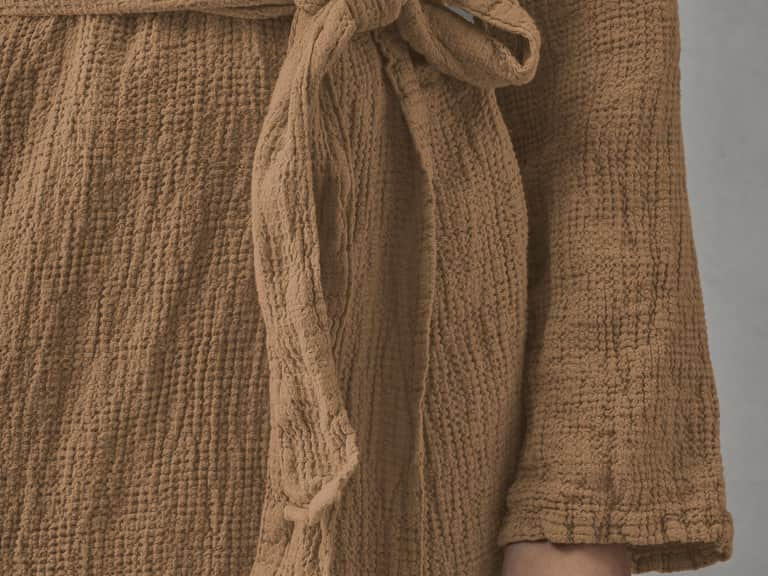
Honeycomb is a descriptive name for a family of woven structures that create a cellular or waffle-like surface. The pattern is produced by changing how warp threads—the lengthwise threads held on a loom—and weft threads—the threads passed across them—interlace. Their arrangement forms small depressions bordered by raised ridges. The result is a fabric with more surface dimension than a simple, flat construction.
That structure is not merely decorative. The varied surface creates small spaces between the cloth and whatever it touches. In a throw, these spaces contribute to a tactile impression of loft and airiness. The raised parts meet the hand first; the recessed areas lend the textile depth and flexibility. As the fabric folds over an arm or sofa back, the cells catch light differently, so the surface can look subtly animated without relying on a printed motif or shine.
Honeycomb structures are often associated with towels and robes, where a textured surface can be useful for absorbency and drying. The Avalon is a throw, however, and its construction should be understood in that context. A three-dimensional weave can feel substantial without making a textile heavy, but its exact warmth and absorbency depend on factors such as yarn, density, dimensions, and finishing. The name of a weave alone does not provide a complete performance specification.
In practical terms, the Avalon’s honeycomb pattern gives it a distinct identity within the broader world of linen throws. The surface has more visual and tactile variation than a smooth, closely woven sheet of cloth. That difference can make the throw feel inviting as a layer on a sofa or chair, while its reported lightness allows it to fold and drape without appearing stiff or bulky.
Linen: a fiber with its own character
Linen is made from flax, a plant whose stalks yield long bast fibers. After processing, those fibers are spun into yarn and woven into fabric. Compared with many cotton fabrics, linen often retains a more pronounced natural irregularity. Small variations in yarn thickness and surface can remain visible in the finished textile, lending it a textured, organic appearance rather than a uniformly smooth one.
These qualities influence how linen feels and moves. The fiber is known for strength, and woven linen can have a crisp hand when new. With use and laundering, it commonly becomes more supple. Its creases are also part of its familiar character: linen bends readily, but does not always return to a perfectly smooth surface. That tendency is not necessarily a defect. In a relaxed home textile, gentle creasing can reinforce the impression of ease and use.
When linen yarns are arranged in a honeycomb structure, fiber and weave work together. The flax provides the underlying feel and resilience; the woven pattern introduces relief and a more articulated surface. The cloth’s drape—the way it hangs, folds, and settles—is shaped by both. A supple yarn in a compact weave will behave differently from the same yarn in a more open or textured construction. The Avalon’s product description emphasizes an airy texture and a beautiful drape, qualities that are best understood as the outcome of this combination rather than a single material claim.
It is also worth distinguishing the fiber from the fabric. “Linen” identifies the material, while “honeycomb weave” describes how the threads are interlaced. “Woven in Portugal” identifies a stage and location of manufacture; “sewn in Canada” describes another. These details offer a more informative account than a broad label alone, though they do not, by themselves, establish every aspect of a textile’s environmental or labor impact.
Texture, lightness, and drape
Texture begins at the surface, but it changes the experience of the whole textile. On the Avalon, raised ridges and recessed cells can make the cloth feel more dimensional under the fingertips. The weave also creates a visual rhythm: small areas of light and shadow repeat across the fabric. In a natural white color, that pattern can remain subtle, shifting in visibility as the throw is folded, spread, or viewed from different angles.
Lightness is a separate quality from softness. A textile may feel light because it has a relatively airy construction or modest mass, while still retaining texture and body. A throw that is too limp may collapse into a narrow bundle; one that is too stiff may resist the contours of a body or piece of furniture. A balanced drape allows the fabric to bend and settle while still preserving enough structure for the weave to remain legible.
In use, drape is easy to notice. Place a throw over the edge of a sofa, and its lower section falls under its own weight. Fold it at the foot of a bed, and it forms a layered edge. Wrap it around the shoulders, and it adjusts to the body’s shape. The Avalon’s 49-by-70-inch dimensions give it a practical scale for these everyday gestures: large enough to serve as a personal layer or furnishing accent, but not so vast that it dominates a room.
Warmth, meanwhile, is influenced by the textile and the conditions around it. A throw can provide a comfortable layer through coverage and the small pockets of air held near the body. Yet no weave can guarantee a particular warmth level for every person or room. Temperature, clothing, airflow, and individual preference all matter. The Avalon is described as lightweight yet cozy, which suggests a versatile layer rather than a heavy winter blanket.
Why construction matters more than a single label
Descriptions such as “natural,” “breathable,” or “durable” can be useful starting points, but they do not replace details about construction and care. Two linen textiles may differ because their yarns, thread density, finishing, and stitching differ. Likewise, two honeycomb fabrics can vary in depth, scale, and firmness. The name of a weave signals a structural family, not a universal specification.
For the Avalon, the available details offer a concise construction profile: 100% linen, a honeycomb weave, Portuguese weaving, Canadian sewing, and a natural-white hue. Its stated dimensions and care instructions add useful context. A reader deciding how to handle the throw should prioritize those specific instructions over general rules for linen, since finishing and assembly can affect how a particular item responds to laundering.
Details such as seams and edges also matter. These areas experience repeated bending and handling, and they can be more vulnerable than the broad surface of the cloth. When laundering, an overcrowded machine may press the throw against other items and increase friction or snagging. Gentle handling helps protect the woven relief, especially if the textile is washed alongside pieces with hooks, zippers, or rough trim.
Laundering a textured linen throw
Care begins before the wash cycle. The Avalon’s care guidance recommends avoiding an overcrowded load, using a fabric bag to help prevent snags, ensuring adequate water, and using maximum water settings. These instructions reflect a practical concern: textured textiles benefit from room to move through water rather than being compressed tightly among other laundry.
The guidance also advises using very little detergent. Excess product may not rinse away fully and can build up in the fibers, changing the feel of the cloth over time. Fabric softener, bleach, detergents containing bleach or whiteners, and alkaline detergents are discouraged. While it can be tempting to add softener in the hope of making linen feel gentler, coatings can interfere with the textile’s own surface and may leave residue. Follow the item’s instructions rather than treating softness as a reason to add more products.
Temperature matters, too. The care notes recommend avoiding hot settings and using medium-temperature settings for washing and drying. They also warn against over-drying. Excessive heat and prolonged tumbling can place unnecessary stress on fibers and seams. Removing the throw when it is dry, rather than leaving it tumbling after the cycle, is a simple way to limit that exposure.
Drying space deserves consideration. The guidance recommends spacing out bed linens and drying only a single sheet set or duvet cover with shams at a time. Although the Avalon is a throw rather than a sheet set, the underlying lesson is relevant: avoid overloading the dryer. A smaller, balanced load gives fabric more opportunity to move freely and reduces the chance of prolonged tangling. For this specific throw, consult its care label and use the product’s instructions as the final authority.
Ironing is not central to linen’s appeal, but it can be used when desired. A warm iron is listed in the Avalon’s care information. If ironing, work with the textile rather than pressing aggressively over the textured surface. The aim need not be to erase every crease. The honeycomb pattern and linen’s natural character are part of the fabric’s appearance; excessive pressure can flatten the relief that gives the throw its visual depth.
Everyday habits that help preserve the weave
Care is not limited to washing. A throw used on a sofa may encounter rough surfaces, sharp hardware, pet claws, or repeated friction at the same fold. Placing it away from abrasive edges and avoiding unnecessary pulling at a snag can help protect the weave. If a loop catches, resist the urge to cut it; trimming may weaken the structure. Instead, handle the area gently and seek appropriate textile repair advice if the damage is significant.
Between washes, airing the throw and folding it loosely can reduce the need for frequent laundering. When storing it for a season, make sure it is clean and fully dry, then keep it in a dry, ventilated place. Avoid compressing it under heavy objects for long periods, which may flatten the textured surface. These measures are modest, but textile longevity often depends on many small choices rather than one dramatic intervention.
Frequent washing is not automatically a sign of better care. The appropriate interval depends on how the throw is used, whether it has been soiled, and household needs. When washing is necessary, a gentle approach with enough room and a thorough rinse is usually preferable to a crowded, aggressive cycle. For stains, avoid improvising with bleach or harsh cleaning agents; check the care instructions and test any treatment cautiously in an inconspicuous area if permitted.
A throw as both tool and object
Textiles occupy a useful middle ground between objects that work and objects that shape a room. The Avalon can provide a layer of comfort, but its surface also changes the atmosphere around it. Honeycomb texture brings a quiet pattern to a plain sofa or bed. Linen’s slight irregularity softens a tightly arranged interior. Natural white can sit comfortably among pale neutrals while still catching enough shadow for the weave to remain visible.
That visual quality is one reason a woven throw can be more than a seasonal accessory. Folded over a chair, it adds a tactile note without requiring a strong color or print. Spread across a bed, it introduces a distinct surface alongside smoother sheets. Because the fabric’s structure is visible at close range and understated from across a room, it can contribute detail without overwhelming other materials.
Pairing textures is more effective when each layer has room to speak. A honeycomb linen throw can be set against a smooth cotton sheet, a fine knit, or a matte upholstery fabric. Too many strongly patterned surfaces may compete; a mix of contrasting textures can instead make differences in weave easier to appreciate. The principle is not a rulebook, but an invitation to notice how cloth responds to its surroundings.
Reading the Avalon in context
The St Geneve Avalon is distinct because several elements meet in one object: a flax-based natural fiber, a honeycomb construction, lightness, a relaxed drape, and a size suited to everyday layering. The weave provides a three-dimensional surface; linen contributes its recognizable texture and capacity to soften with use. Together, they create a throw whose appeal lies as much in the way it hangs and feels as in its clean, natural-white appearance.
Its care instructions are part of that story. The fabric is not simply a surface to be enjoyed; it is a structure to be maintained. Room in the wash, restrained detergent, moderate temperatures, and careful drying help limit the stresses of routine laundering. Avoiding bleach, fabric softener, and over-drying supports a more considered approach to preserving the textile’s texture and integrity.
For readers interested in the object itself, the St Geneve Avalon Linen Throw is listed with details on its honeycomb weave, 100% linen construction, dimensions, and care. Those practical particulars provide a useful companion to the broader lesson of textile literacy: a fabric’s behavior can often be understood by looking closely at how it is made and how it is treated.
Every weave has its own way of holding air, light, and movement. The Avalon’s honeycomb pattern makes those qualities perceptible in a small domestic landscape: the raised cells under the hand, the gentle folds across a chair, the changing shadows along a draped edge. Read carefully, a throw is not just a finishing layer. It is a piece of construction—fiber and thread arranged to shape the experience of comfort.